Research
Interests
|
A variety of non-specific
nucleases are involved in cell defense by degradation of foreign or host
nucleic acid molecules in
prokaryotes and eukaryotes. We are interested in understanding and comparing the ways of how these
nucleases are regulated, how they recognize DNA/RNA, and how they cleave phosphodiester linkages, using a combination of
structural, biochemical and biophysical approaches. Bacterial
non-specific nucleases in cell defense We
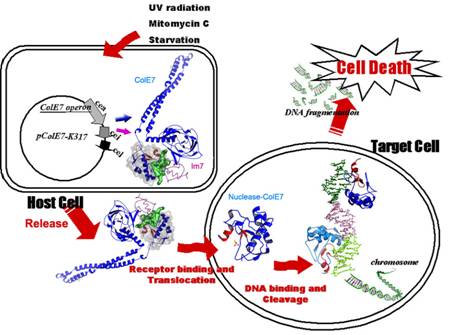
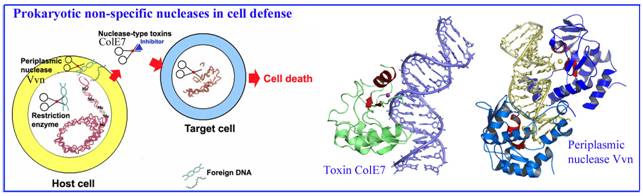
have been working on two types of sugar non-specific nucleases in bacteria,
including a periplasmic nuclease Vvn and a secreted
toxin ColE7, both of which digest foreign nucleic acids for cell
defense. Based on our
structural and biochemical analysis on Vvn and
ColE7, we have provided a solid foundation to explain how these nucleases are
inhibited and activated, how they recognize DNA without sequence specificity
and how they digest DNA to protect bacterial cells at atomic level. |
|
|
|
|
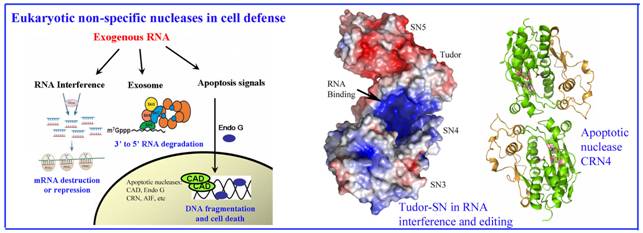
Eukaryotic nucleases in
cell defense We also extend
our investigation to the eukaryotic non-specific nucleases involved in cell
defense. Specific projects include structural and functional studies of
apoptotic nucleases participating in chromosome fragmentation in apoptosis,
and a number of RNases involved in mRNA degradation
and miRNA biogenesis. For example, we solved the
crystal structure of a cell-death-related nuclease (CRN4) which suggests how
this protein binds and cleaves DNA in program cell death. Our structural and
biochemical analysis on human Tudor-SN suggests how this protein grasps
hyper-edited miRNA and plays a role in RNA editing
and interference. The long-term goal of this research is to establish a
molecular basis for how a nuclease may be involved in promoting or
suppressing cell survival machinery. |